
Features
Astrology Chart Views
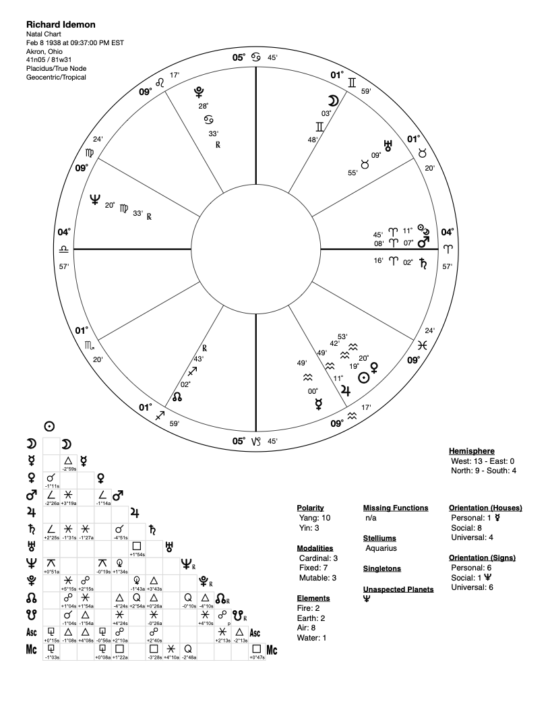
Chart View
This sleek uniwheel showcases a singular astrological chart, enhanced by an aspect grid and an Idemon legend. The aspect grid effectively highlights planetary contacts, illustrating both applying and separating orbs. Meanwhile, the Idemon Legend draws from Richard’s innovative “artist sketch” method of organizing chart information, providing us with an intuitive understanding of the chart at a mere glance.
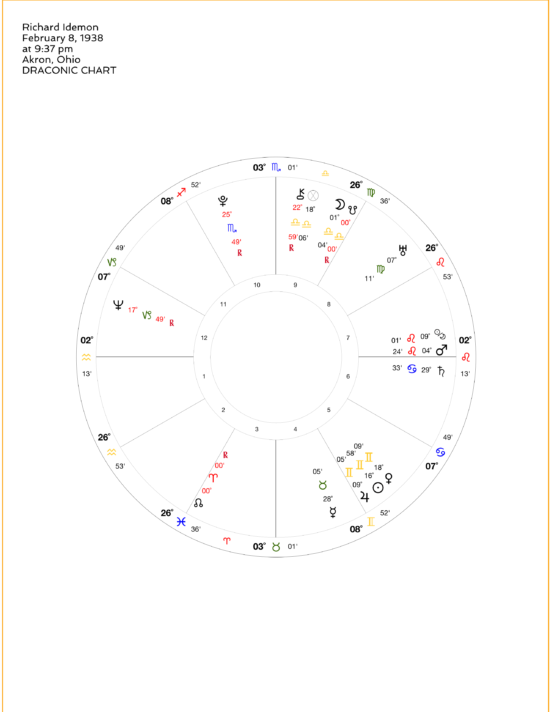
Draconic Chart
Also known as a soul chart due to its connection with the Lunar Nodes. The Draconic chart moves the North Node to 0° Aries, and all the other planetary points remain in the same degree relationship as the natal chart. This realignment reveals deeper, often unconscious, motivations and life lessons, potentially highlighting past life influences and the soul’s journey.
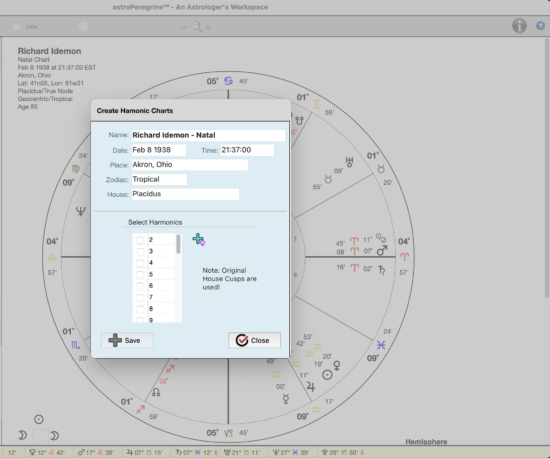
Harmonic
A harmonic chart is a type of astrological chart that explores the intricate relationships between planets through mathematical divisions of the zodiac. They create a new version of the chart, calculated by a specific aspect, which reveals underlying patterns and energies that may not be readily apparent in a traditional birth chart.
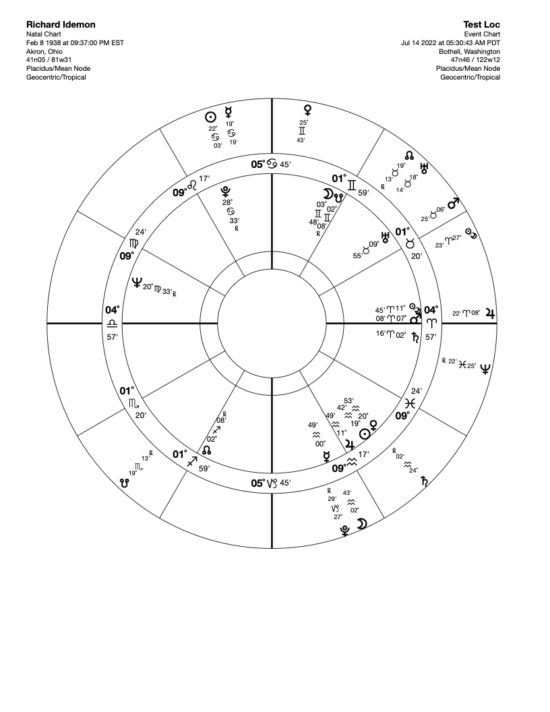
Bi-wheel
The Bi-wheel is an invaluable tool for synastry and predictive interpretation, by displaying in the same wheel distinct charts. In Synastry, the natal chart of two individuals can give us a picture of the relationship and dynamics between their planets and points. While under a predictive context, this interplay between charts allows us the simultaneously viewing of a natal chart with various time-sensitive charts such as transit, solar arc, or progressed charts.
Animated Features
Easy Rectification & Electional

Electional
With one simple click, move the chart time to elect the best chart.

Rectification
With one click, move the time to rectify the chart.
Animated Bi-Wheels & Tri-Wheels
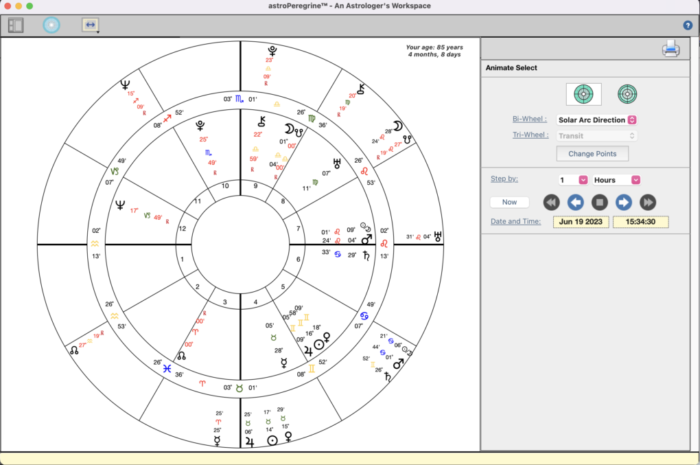
Animate bi-wheels
Toggle instantly between a static view and an animated bi-wheel with a single click. We’ve also included a dedicated space to document and switch between life events.

Animated Tri-wheel
Quickly animate Tri-wheels.
Reports & Forecast

Phasal Aspect Grid
Visualize the phasal relationships between any two planets using the Phasal Aspect Grid. This feature displays the specific aspects formed and the precise number of degrees between them. Users can customize their view by selecting from several measurement options, including Chaldean, EA, Fast to Slow, and traditional methods.

Dispositor Tree
A dispositor tree illustrates the astrological connections between planets. It diagrams a planet and its dispositor, which is the planet ruling the sign it occupies. This type of tree simplifies the identification of final dispositors and mutual receptions by sign, as it covers all planets.
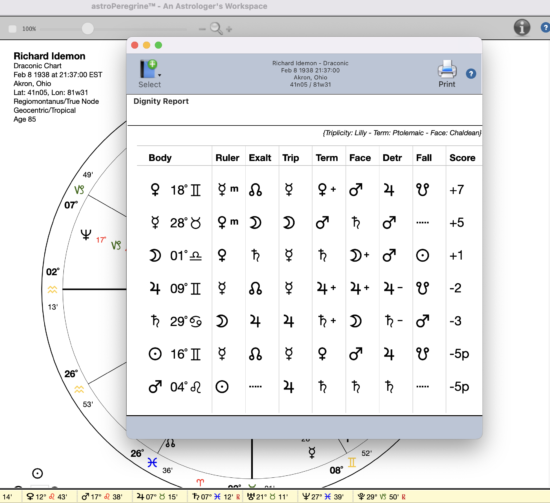
Essential Dignities Table
The Essential Dignities table provides a comprehensive overview of planetary strength and condition based on zodiacal position. Users can fully customize this table by selecting their preferred calculation methods for Triplicities, Terms, and Face (Decans), ensuring the data aligns with specific astrological traditions or personal practice.

Midpoint Tree
Midpoint trees illustrate the connections between midpoints and other celestial points or planets, forming what is known as a Midpoint Picture. To simplify the analysis of these intricate planetary configurations, astroPeregrine provides a refined, single-page layout that enables an immediate and effortless interpretation of complex structures at a glance.

Midpoint List
The Midpoint list offers a listing of all midpoints in order, serving as a primary tool for identifying all the midpoints within a chart. To accommodate various astrological methodologies, you can select from different calculation options ranging from 22.5 to 360 degrees.

Midpoint list with Orb
You are able to highlight any midpoint within your preferred orb.

Timescan
Generate a comprehensive list of planetary contacts to a radix by selecting a specific timeframe, incorporating transits, solar arcs, and secondary progressions. This data can be viewed directly on-screen or exported to a printer, which also provides the option to save the results as a PDF document.

Midpoint list no birthtime
When there is an unknown time of birth, you can select to gray any time-sensitive midpoint.

30˚ Modulus Report
The 30˚ Modulus Report organizes planets by their degree order, a feature particularly beneficial for Horary Astrology as it simplifies the identification of applying and separating aspects. Additionally, the report details each planet’s speed regardless of its direction and provides the average speed as a benchmark for assessing the planet’s current condition.

Declination
The Declination table shows the distance of each planet from the Celestial Equator. It includes a notation for each planet that is “Out of Bounds.”
Add-on astroCartography

Astro-Cartography module
Available in a bundle or as an add-on.